Hydro Jetting
High-pressure pipe cleaning, and an honest account of the pipes it is wrong for.
San Diego water, leak, drain and sewer diagnostics — find the source before anyone opens a wall.
WaterLine ExpertsIt is a question about your pipe. Two contractors can give you two different answers honestly, because the right choice depends on what the line is made of and what condition it is in — which is something you look at, not something you infer.
Tell us what the line has been doing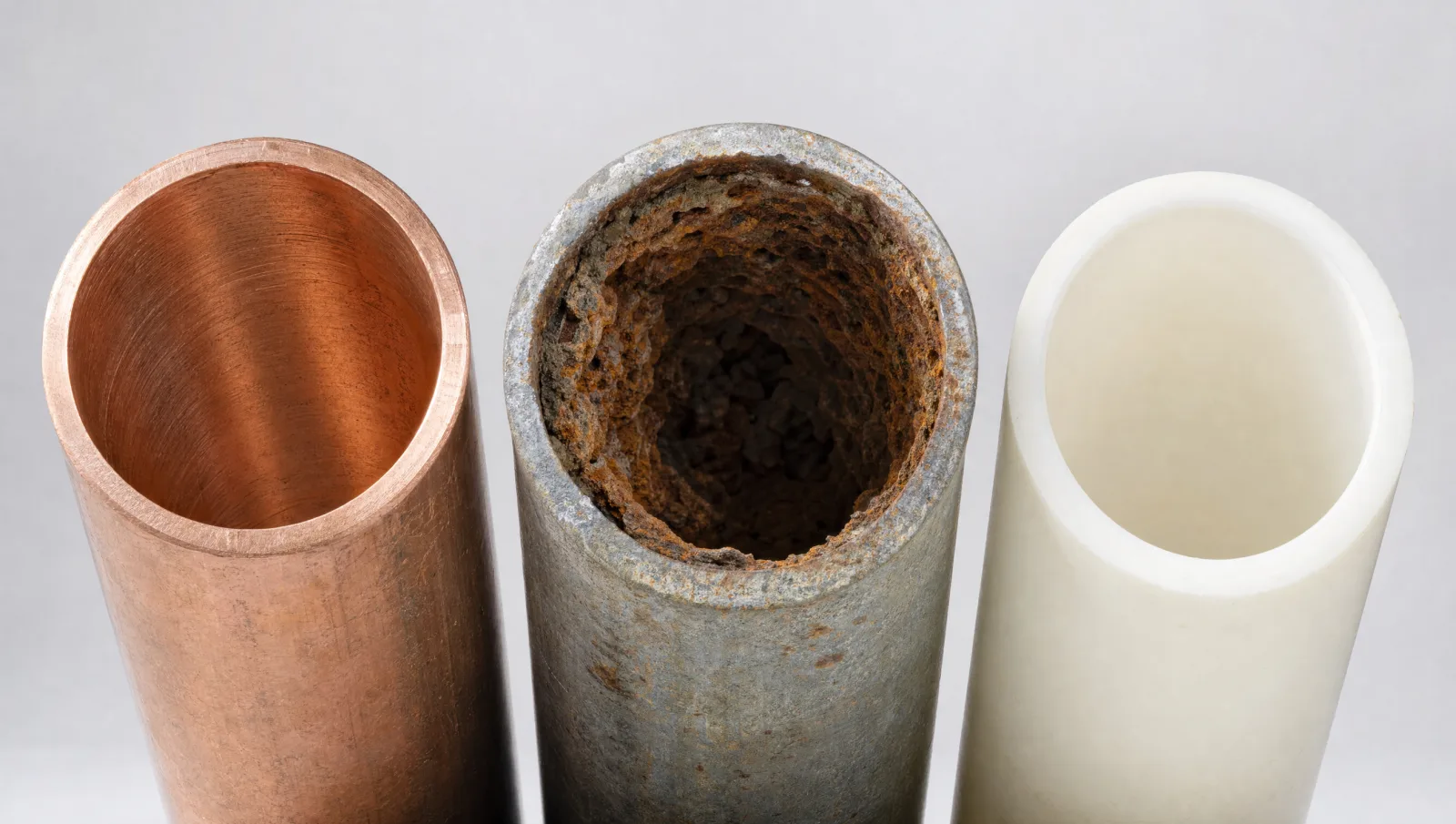
The hydro jetting vs snaking decision is easier to make once you picture the two operations, because they are not the same job at different intensities — they are different jobs. A cable machine, snake or auger feeds a rotating steel cable down the line with a cutting or retrieving head on the end. It bores through the obstruction. Flow returns immediately, and what the cable removes is whatever it happened to catch and drag back. The pipe wall is largely untouched, so a line coated in grease or scale is still coated in grease or scale, now with a hole through the middle of the blockage. A jetter feeds a hose with a nozzle that fires water backward at high pressure against the pipe wall. The reaction drives the nozzle forward, and the jets scour the full internal diameter, lifting grease, scale and root hair and flushing them downstream. What comes back is a pipe closer to its original bore, which is why the interval before the next problem is genuinely reset rather than shortened. The catch is that pressure does not distinguish between deposit and pipe. On a sound line that is exactly what you want. On an old clay line with offset joints, or cast iron corroded thin, or a section already cracked, the same pressure that removes the deposit can work on the defect too. That is the entire reason the honest answer is "look first" rather than "jetting is better".
| Snaking / cabling | Hydro jetting | |
|---|---|---|
| What it does to the blockage | Bores a channel through it, and retrieves whatever the head catches on the way back. | Scours the full pipe diameter and flushes the material downstream. |
| What it does to the pipe wall | Very little. A grease lining or scale layer is still there afterwards. | Removes the lining as well as the blockage, restoring most of the original bore. |
| How long the result lasts | Until the channel closes again — often a similar interval to the last time. | Longer, because the material that was narrowing the pipe has actually left it. |
| Best case for it | A discrete obstruction: something flushed or dropped, a hair mass, a single localised jam. | Recurring blockages from grease, scale, or fine root hair in structurally sound pipe. |
| When it is the wrong tool | A line that has been cleared before and keeps returning — it treats the symptom, on a timer. | Fragile, cracked, badly offset or heavily corroded pipe, where pressure can worsen an existing defect. |
| What it needs beforehand | Access to a cleanout. Often done without ever seeing inside the line. | A camera pass, so the pipe condition is known rather than assumed. |
| What it tells you about the cause | Little, unless something identifiable comes back on the cable. | More, because the wall is visible afterwards — a post-jetting camera pass shows what was under the deposit. |
| Effect on roots | Cuts them back to the pipe wall. They regrow toward the same moisture, through the same opening. | Removes root hair more completely, but does not close the fault that let them in — that needs a repair. |
Shows the pipe material, the thickness of any deposit, root intrusion, cracks, offset joints, sags, and the distance to each. It is what makes the jetting-or-cabling choice a decision rather than a preference.
Reopens flow quickly through a discrete obstruction, in a range of cable sizes for branch lines through to laterals. Gentle on nothing in particular — an aggressive head on thin old pipe is its own risk.
Scours the pipe wall at a pressure and nozzle pattern chosen for the line. The nozzle choice matters as much as the machine: the same unit can be run appropriately or inappropriately for a given pipe.
Proves the wall is clear rather than merely flowing, and records what the pipe looks like underneath the deposit that was hiding it. Also the baseline for judging any future recurrence.
A camera pass is a separate operation. On a first-time blockage it is sometimes skippable; on a repeat, skipping it is what causes the third visit.
An accessible cleanout makes either method straightforward. No cleanout means creating access, and that is work before any work.
A branch line under a sink and a lateral running the length of a property are different equipment and different amounts of time.
Sound modern pipe takes the direct approach. Old clay or corroded cast iron needs care, sometimes a different method entirely, and sometimes repair instead of cleaning.
A collapsed section, a bad sag, or roots through a failed joint are structural. Cleaning them is a recurring cost rather than a fix, and the camera is what reveals which situation you are in.
Quite possibly both, from different information. If one has seen inside the line and the other has not, that is not a difference of opinion, it is a difference of evidence. The question worth asking each of them is what they saw and at what distance — an answer expressed in feet and defects is a different kind of answer from one expressed in method preference.
It can, and that is exactly why the pipe gets looked at first. Old clay with offset joints, cast iron corroded thin, or a section already cracked are all cases where high pressure can enlarge a defect that was previously just leaking. On sound pipe, jetting is the more thorough option and the risk is minimal. There is no way to know which you have without looking.
No, and anyone saying otherwise is overselling it. Jetting removes root hair far more completely than a cable does, which buys a substantially longer interval — but roots got in through a crack or a failed joint, and that opening is still there afterwards. Closing the entry point means relining or replacing the affected section. Cleaning is maintenance; the repair is what ends it.
Not necessarily. Restoring flow is a reasonable first move when a household has no working drainage, and inspection can follow once the line is passable — a camera cannot see past a solid blockage anyway. What matters is that the inspection actually happens afterwards if the blockage was not a one-off, rather than being quietly dropped once things are draining.
It depends on whether this is the first blockage or the fourth. A kitchen line blocks because grease has been lining it for years, and cabling does not remove that lining — so on a line with a history, jetting is the option that changes the interval rather than resetting it. On a genuine one-off, cabling is proportionate.
Neither does. A collapsed or badly offset section is a structural failure, and both methods are ways of removing material from inside a pipe that still has its shape. If a camera shows collapse, the conversation moves to repair or replacement of that section, and continuing to clear it is paying repeatedly for the same few months.
How often it blocks, what has been done before, and whether anyone has had a camera in it. If you have footage from a previous visit, that is the fastest way to get a straight answer about which method your pipe can take.
Request ServicePrefer to call? (619) 391-3249