Drain cleaning in San Diego, and what a clog that keeps coming back means

Clearing a blocked drain is the easy half. The half that decides whether you are back here next year is what the pipe looks like once the water is moving again.

Describe what is draining slowly
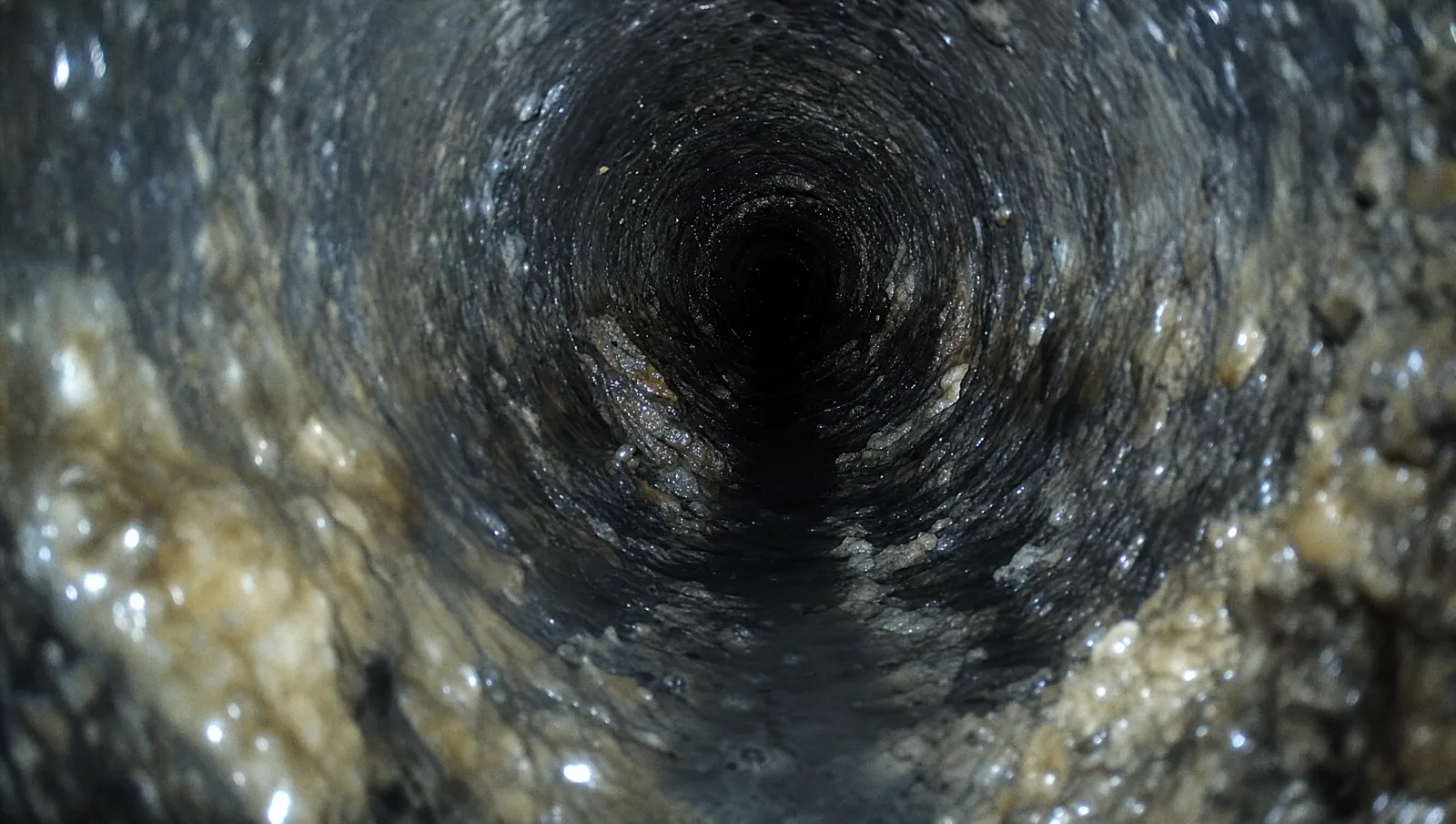
Interior view along a residential drain pipe whose wall is coated in greasy buildup, narrowing the open channel.

What usually brings people here

  • One fixture drains slower every weekA narrowing channel rather than a sudden obstruction. Something is building up on the pipe wall, and the drain will keep working right up until it does not.
  • The same drain blocks about once a yearThe strongest single sign that previous clearings punched a channel through the problem rather than removing it. An annual cycle is a pattern, and patterns have causes.
  • The toilet gurgles when the shower or washing machine runsAir being pulled through a trap seal because drainage they share is restricted. One fixture reacting to another means the restriction is downstream of both — a shared branch, the main line, or a vent.
  • Water backs up into a different fixtureThis moves the problem out of the individual drain entirely. Waste is finding the lowest available opening, which happens when the shared line below cannot take what is being sent into it.
  • A smell from the drain that comes and goesSometimes buildup in the pipe holding organic material. Sometimes a dried trap or a venting fault, which is a different problem with the same symptom, and worth separating before anything is cleared.
  • It drains fine, then floods when the washing machine emptiesVolume is the test. A restricted line copes with a slow trickle and fails on a fast, large discharge, so appliance cycles are frequently the first thing to expose it.

Why a cleared drain so often has to be cleared again

A blockage is rarely a single object sitting in an otherwise clean pipe. What builds up on the inside wall of a drain — congealed grease and soap residue on a kitchen or laundry line, scale on old pipe, hair and organic matter in a bathroom branch, fine root hair where a joint underground has failed — narrows the working diameter of the pipe gradually. The clog is the day the narrowed channel finally closes. That matters because of what most clearing methods actually do. A cable machine, a snake, or an auger drives a cutting head through the obstruction and opens a passage. Water moves again, the fixture works, and the visit reads as a success. But the material that narrowed the pipe is still on the wall, still catching what goes past it, and the channel starts closing again from the day it was opened. That is the entire mechanism behind a drain that blocks on a roughly annual schedule. There is a second, more serious version of the same story. If the narrowing is caused by a defect in the pipe itself — a crack letting roots in, a joint that has separated, a section that has sagged so waste settles in it rather than flowing past — then no amount of cleaning is a repair. Clearing it will work, briefly, every time, forever. The only useful question at that point is what the inside of the pipe looks like, which is a camera question rather than a cable question.

Why the pipe wall matters more here

One local factor sits underneath the pattern described above. The water is hard — the city's own reporting puts total hardness in the region of 216 to 284 ppm, about 12.6 to 16 grains per gallon, varying by treatment plant and with the seasonal blend of Colorado River and State Water Project water. On a drain, that shows up as scale forming on the inside surface, most readily in the lines that carry warm water away: kitchen, laundry, shower. It does two things, and the second is the one that matters. It narrows the bore, so the pipe starts from less than its full diameter. And it turns a smooth wall into a rough one, which gives grease, hair, and solids somewhere to catch instead of being carried out. A scaled drain does not merely clog more often; it clogs from things a clean pipe of the same size would have flushed away. That is the missing half of why a cleared drain comes back. Cabling opens a path through the obstruction, but it leaves the rough, narrowed wall that recruited the obstruction in the first place. The effect is uneven — modern plastic takes scale far less readily than old cast iron or galvanised — so the pipe material in your house decides how much of this applies, which is another reason the camera pass is worth its time.

How a slow drain escalates

How a slow drain escalatesSlow drain leads to Recurring clog leads to Multiple fixtures leads to Possible main line.Slow drainRecurring clogMultiple fixturesPossible main line
Each stage widens where the fault can be. Once more than one fixture is involved, the individual drain is no longer the subject.

Working out what is actually in the pipe

  1. Establish how many fixtures are affectedOne slow sink is a branch-line problem. A sink, a shower, and a toilet misbehaving together is a shared-line problem, and no amount of work on the individual fixture will touch it. This costs nothing to determine and changes everything that follows.
  2. Find out what has been done beforeHow many times it has been cleared, how long each clearing held, and what was used. A drain cleared twice that held twelve months each time is telling a different story from one blocked for the first time in twenty years, and the second one is far more likely to be a one-off.
  3. Restore flowClearing comes first because a camera cannot see through standing water and a blocked line cannot be assessed. This is the part most visits stop at; here it is a prerequisite for the next step rather than the conclusion.
  4. Put a camera down the lineWith the line flowing, a camera shows what the pipe is made of, how much material is still on the wall, and whether there is a defect — root intrusion, a crack, an offset joint, a low section holding water. It also gives a distance measurement, which is what turns "there is a problem somewhere" into a specific location.
  5. Separate cleaning from repair, honestlyIf the pipe is sound and dirty, cleaning is the answer and it will hold. If the pipe is damaged, cleaning is a temporary measure and should be described as one. Selling a third clearing on a broken line is how people end up paying for the same job repeatedly.

Cabling and jetting are not the same job

Cabling and jetting are not the same job
 Cable machine / snakeHydro jetting
What it does to the blockageDrives a cutting head through it and opens a passage.Scours the full inside diameter with high-pressure water and flushes the material out.
What it leaves behindThe buildup on the pipe wall, which starts narrowing the channel again immediately.A pipe wall close to its original diameter, assuming the pipe is sound enough to take the pressure.
Best suited toA discrete obstruction, a one-off blockage, a fixture that has never done this before, or restoring flow quickly so the line can be inspected.Recurring blockages, grease-lined kitchen and laundry lines, scale, and root hair in a line whose condition has been confirmed.
Risk on old pipeLower pressure risk, but a cutting head can still catch and damage a joint that has already failed.Real. High pressure inside a cracked, badly corroded, or offset pipe can make a bad section worse, which is why a camera pass should come first.
What it cannot fixAnything structural. A broken pipe clears and re-blocks.Also anything structural. Jetting cleans a damaged pipe very thoroughly and it is still a damaged pipe.

What the camera pass leads to

Clean it and leave it

Fits when: The pipe is intact, the material was buildup, and the cause is explainable — a kitchen line that has had years of grease through it, a bathroom branch full of hair.

Trade-off: The least expensive answer and the right one more often than people expect. It relies on the camera having actually looked, because "the pipe is fine" is a claim, not a default.

Clean it and change what goes into it

Fits when: A recurring blockage with a behavioural cause — grease down a kitchen sink, wipes through a toilet, a laundry line taking lint with no filter.

Trade-off: Costs nothing extra and works, but only if the actual cause was identified rather than assumed. It is worth saying plainly: some recurring clogs really are a habit rather than a defect.

Spot repair the defective section

Fits when: The camera finds one identifiable fault — a cracked length, a separated joint, a section crushed by something — in a line that is otherwise in reasonable condition.

Trade-off: Fixes the actual cause for far less than replacing the run. It depends on the rest of the line genuinely being sound, which is a judgement about pipe material and age as much as about the footage.

Repair or replace the run

Fits when: Damage in multiple places, a material that is failing generally, or a sag that means waste settles somewhere along the line every time it is used.

Trade-off: The large answer, and the only one that ends a genuine structural problem. This is a sewer line conversation rather than a drain cleaning one, and it deserves its own inspection and its own decision.
What moves the number on a drain job

Where the access point is

A line with a proper cleanout is straightforward to work on. A line with no accessible cleanout has to be entered through a fixture or opened up first, and that is time before any clearing begins.

How far along the line the blockage sits

A trap or a branch a couple of metres in is a different job from an obstruction fifteen metres down the main, both in equipment and in how long it takes to reach.

What the blockage is made of

Soft material clears quickly. Compacted grease, hardened scale, and root mass each take longer and frequently need different equipment than the first attempt used.

Whether the line gets inspected

A camera pass adds time to the visit. It is also the only thing that distinguishes a pipe that needed cleaning from a pipe that needs repairing, so leaving it out is how a cheap visit becomes a repeated one.

Pipe material and age

Old clay, cast iron, and modern plastic tolerate cleaning methods differently. Condition decides which method is safe, and the safe method is not always the fast one.

Whether it is one drain or the shared line

Clearing a fixture branch and clearing a main sewer line are different scopes of work, and which one you have is established before the price is, not after.

Where recurring drain problems come up most

Chula Vista's older bayside core, La Mesa's mature street trees over ageing clay laterals, and Carlsbad's pockets of older housing are the three places a recurring clog is most likely to be a symptom of something upstream rather than a one-off.

    Questions people ask

    Why does my drain keep clogging after it has been snaked?

    Because snaking usually opens a channel through the blockage rather than removing what caused it. Flow returns, the problem reads as solved, and the buildup — grease, scale, hair, or root hair coming in through a failed joint — is still on the pipe wall narrowing it again from that day on. A clog that returns on a roughly annual cycle is that mechanism, not bad luck.

    Are chemical drain cleaners worth trying first?

    They sometimes clear a soft, shallow blockage in a fixture trap. They do very little to grease further down a line, nothing at all to roots or a structural defect, and repeat use is unkind to older pipe and to the person who opens the trap afterwards. If a drain has blocked more than once, the useful spend is on finding out why rather than on another bottle.

    My toilet gurgles when the washing machine drains. Is that urgent?

    It is worth investigating rather than ignoring. Gurgling means air is being pulled through a trap seal because drainage the two fixtures share is restricted. One fixture reacting to another is the tell that the restriction is downstream of both. It is frequently the early stage of a main line problem, and investigating at the gurgling stage is considerably less disruptive than at the backup stage.

    Do you need to see inside the pipe, or can you just clear it?

    Clearing it is possible without looking, and for a first-time blockage with an obvious cause that is often reasonable. What a camera adds is the answer to whether it will come back — whether the line is sound and was dirty, or damaged and will re-block regardless. If a drain has been cleared before, skipping the inspection means buying the same result again.

    Should I just have it jetted to be thorough?

    Not automatically. Jetting is the more thorough clean and it is the right call for recurring grease, scale, and root problems — but high pressure inside a pipe that is already cracked, badly corroded, or offset can make the damage worse. That is exactly why the camera pass comes before the decision rather than after it.

    Multiple drains are slow at once. Is that the same problem?

    No, and this is the most useful distinction on this page. One slow fixture is usually its own branch. Several fixtures slow or backing up together means the line they share is restricted, which points at the main drain or the sewer lateral. Working on the individual fixtures in that situation spends money on the wrong pipe.

    How long should a drain stay clear after it is cleaned?

    If the pipe is sound and the buildup was genuinely removed, years — for a kitchen line, that depends partly on what goes down it afterwards. If it blocks again within months, the honest reading is that the cause was not addressed: either the cleaning was a channel through the material, or the line has a defect that keeps catching what passes.

    Describe what is draining slowly

    Which fixtures, how long it has been happening, and whether it has been cleared before — including how long that clearing held. That last detail is the one that decides whether this is a cleaning conversation or an inspection one.

    Request Service