Leak detection in San Diego, before anything gets opened up

A leak announces itself somewhere convenient and starts somewhere else. Locating equipment closes that gap, so the only thing that gets opened is the part with the leak in it.

Describe what you have noticed
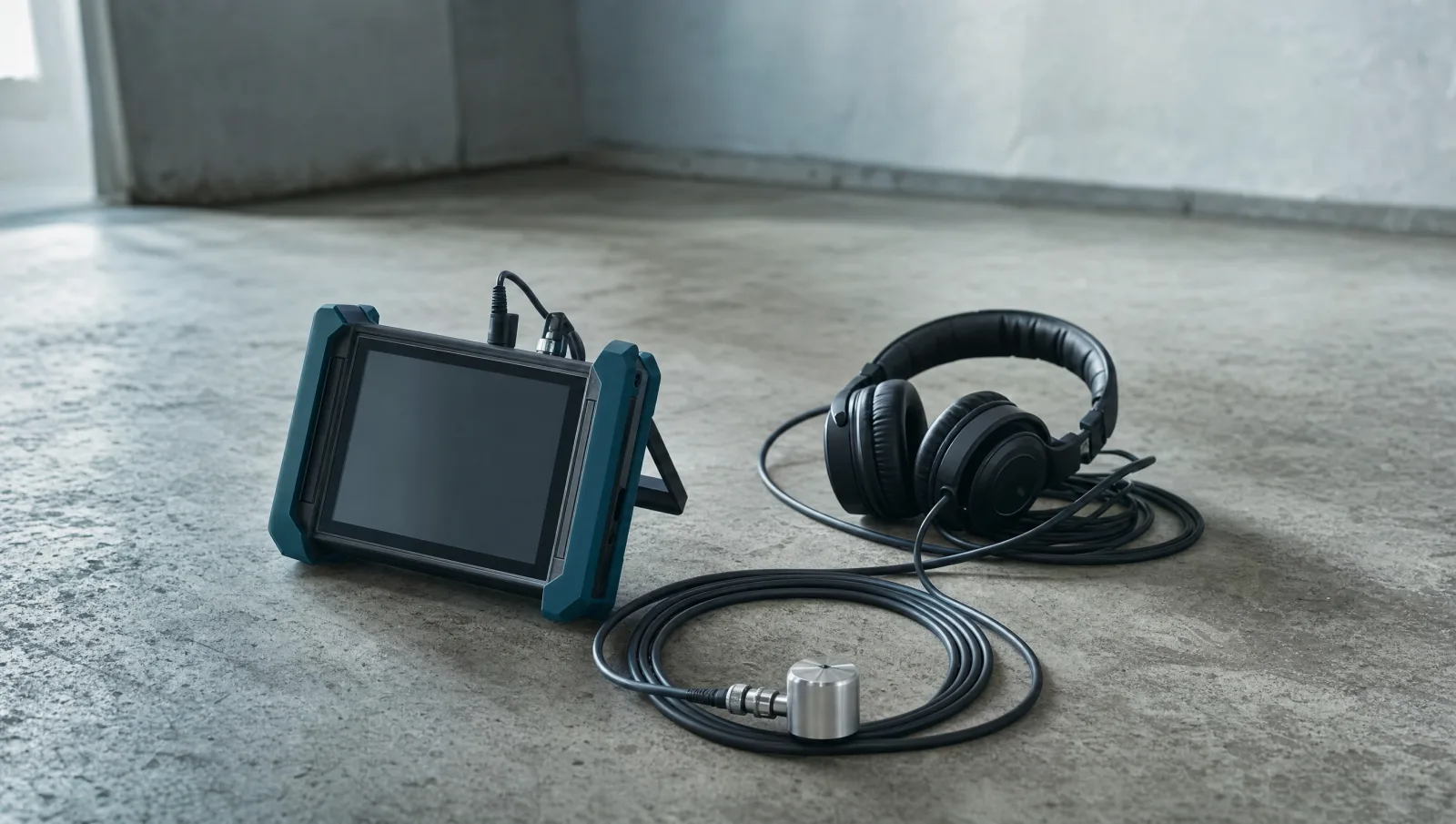
Acoustic leak locating equipment — a ground microphone probe and headphones on a coiled cable — resting on a bare interior floor.

What usually brings people here

  • The bill went up and nothing about the house changedThe most common first sign of a leak with no visible surface. The water is being metered, so it is going somewhere.
  • The meter keeps moving with everything turned offThis is close to conclusive. Something downstream of the meter is passing water continuously.
  • Damp, staining, or a musty smell with no fixture above itWater travelled to get there. The visible damp marks the end of its path, not the beginning.
  • Pressure has dropped, or drops when nothing else is runningA supply line losing water loses pressure with it. Sudden changes matter more than the absolute number.
  • The sound of running water with the house quietPressurised water escaping through a small opening makes a continuous, locatable noise. That noise is what acoustic equipment listens for.
  • A patch of the yard that stays green or softClassic for a leak on the service line between the meter and the house, where nothing indoors would show at all.

Why finding it is the hard part

Repairing a leak is generally straightforward once you are looking at it. Everything difficult and everything expensive is upstream of that: knowing which pipe, and where along it. Pressurised water takes the path of least resistance through whatever is around it — under a slab, along a trench line, down inside a wall cavity, across a subfloor. By the time it reaches a surface you can see, it may be several metres from the failure and on the other side of a wall. That is why "just open it where it is wet" is such a reliably expensive approach: it produces a hole, an intact pipe, a repair bill for the hole, and the original leak still running. Locating works the other way round. It uses what the leak itself is doing — the noise it makes, the heat it carries, the pressure it loses — to narrow the possible area until one spot is left.

How the search actually narrows

  1. Confirm there is a leak at allIsolate the system and watch the meter. This separates a genuine leak from high usage, a running toilet, or an irrigation fault — three things that produce the same bill and none of which need locating equipment.
  2. Split the system into sectionsShut off zones one at a time to establish which side the loss is on: service line before the house, hot side, cold side, or irrigation. Each isolation removes a large area from consideration at no cost.
  3. ListenGround microphones and amplified listening equipment pick up the sound of water escaping under pressure, conducted through soil and concrete. The signal is strongest directly above the failure, which is what turns a section into a spot.
  4. Cross-check with a second methodThermal imaging traces a hot-line leak by the warm track it leaves; where a line cannot be heard clearly, tracer gas or line tracing confirms depth and route. Two methods agreeing is the standard for marking a spot — one method alone can be fooled by a noisy fitting or a warm run of pipe.
  5. Mark it, then talk about accessOnly once the location is confirmed does the conversation turn to what reaching it involves. That is a separate decision, made with a number and a place rather than a guess.

What each instrument can and cannot see

Acoustic ground microphone

Hears pressurised water escaping through a small opening, through concrete and soil. Excellent on pressurised supply lines; deaf to a drain or sewer line, which is not under pressure and makes no such noise.

Thermal imaging

Shows surface temperature differences, which traces a hot-water line leak clearly. It sees heat, not water — a cold-side leak is close to invisible to it, which is why it is a confirming instrument rather than a primary one.

Pressure testing and isolation

Proves which section of the system is losing water and how fast. Costs nothing but time and eliminates whole areas, which is why it comes before anything else.

Line tracing

Establishes where a buried line actually runs and how deep. Useful because assumed pipe routes are wrong often enough to matter, especially where work has been done before.

Moisture meters

Maps how far moisture has spread through a material. Tells you the extent of the damage, not the source of it — the wettest reading is frequently nowhere near the leak.

The order the work runs in

The order the work runs inSymptom leads to Inspection leads to Isolation leads to Detection leads to Repair recommendation.SymptomInspectionIsolationDetectionRepair recommendation
Each step is chosen to remove the largest possible area from the search next.

Once it is located

Spot repair

Fits when: A single failure on a line that is otherwise in sound condition — a joint, a nail through a pipe, a discrete defect.

Trade-off: The least invasive and least expensive route. It assumes the rest of the line is fine, which is a reasonable assumption only when the pipe material and age support it.

Reroute the affected line

Fits when: The failure is under something expensive to open — a slab, a driveway, a finished floor — and there is a practical path around it.

Trade-off: Avoids breaking concrete entirely. Costs more pipe and leaves the old section abandoned in place, which is normal and not a problem in itself.

Open and repair in place

Fits when: Access is straightforward, or a reroute is not practical for the run in question.

Trade-off: Direct and durable, with the cost sitting in the access and the making-good rather than the plumbing.

Repipe the section or the house

Fits when: Repeat failures on the same system, or a pipe material that is failing by age rather than by accident.

Trade-off: The largest job and the only one that stops the pattern. Worth raising honestly when a second or third leak appears on the same lines, and worth arguing against when it does not.
What actually moves the number

How much of the system has to be eliminated

A leak that isolates to one zone in ten minutes is a shorter job than one that could be on any of four systems.

What is over the top of it

Bare soil, a slab, a tiled floor, and a poured driveway are four different access problems for the same length of pipe.

Depth and route of the line

A deeper or longer run takes longer to trace and longer to reach, and route assumptions are wrong often enough to matter.

Whether the pipe is a one-off failure or an ageing system

This is the difference between a repair and a replacement conversation, and it is why the pipe condition gets assessed rather than assumed.

How far the water has already spread

Drying and making good is frequently the larger half of the total, and it grows the longer a leak runs.

Leaks in San Diego housing

Slab-on-grade construction is common across the county, which puts a lot of supply pipe inside concrete where there is no access panel and nothing to lift. That single fact is why locating equipment matters more here than in housing stock built over crawlspaces — the alternative to locating is not "looking", it is breaking concrete speculatively. Hard water is the other local factor with a direct bearing on where leaks come from. San Diego’s supply runs to roughly 216 to 284 parts per million total hardness by the city’s own reporting, varying by treatment plant and by the seasonal blend of imported water. Sustained mineral content attacks copper from the inside, and the failure it eventually produces is a pinhole — a very small opening, on a line that has been fine for thirty years. That is worth knowing before a search starts, because a pinhole is exactly the kind of leak that loses enough water to move a bill while showing nothing at all indoors. The range of housing age in a small geographic area matters too. Where an older home is still on original galvanised supply, the pipe tends to corrode along its length rather than fail at one point, and that pattern changes the answer to "repair or replace" before anyone has looked at a single joint.

Where this comes up most

Leak detection questions arrive from across the county, but three patterns show up often enough to name: older, denser neighbourhoods in San Diego proper on original supply lines; El Cajon's inland heat compounding hard-water pinhole leaks; and Oceanside's sandy coastal soil, which lets a leak run longer before it surfaces.

    Questions people ask

    How do I know whether I actually have a leak before calling anyone?

    Turn off every fixture and appliance that uses water, then look at the meter. Most have a small dial or triangle that turns with any flow at all. If it moves with everything off, water is going somewhere. If it does not move over fifteen minutes, the bill probably has a different explanation — irrigation and a slow-running toilet are the usual two.

    Do you have to break concrete to find a slab leak?

    No. Locating happens through the slab — acoustic equipment hears the escaping water, thermal imaging traces the warm path of a hot-side leak. Breaking concrete is part of a repair once the location is confirmed, and there is often a reroute option that avoids it. Anyone opening concrete in order to find the leak has the order backwards.

    Can you find a leak in a drain or sewer line the same way?

    Not with acoustic equipment, because those lines are not under pressure and make no continuous escape noise. Drain and sewer faults are found by camera inspection and, where needed, by isolating and testing the line. It is a different method for a genuinely different problem.

    The damp is in one room. Is that not where the leak is?

    It is where the water surfaced, which is a different thing. Water runs along joists, down cavities and across subfloor before it appears, so the visible damp is the end of the path. Moisture mapping shows how far it has spread; locating equipment finds where it started.

    What if you cannot find it?

    Then we say so, tell you what has been ruled out and what it would take to go further, rather than opening something speculative to be seen doing something. A confirmed "not on this system" is a real result and it narrows the next step.

    Describe what you have noticed

    What you saw, where, and roughly when it started. If you have checked the meter with everything off, tell us what it did — that one detail changes where we start.

    Request Service