Sewer line repair in San Diego, matched to what the camera actually found

There are four honest answers to a failing lateral and they differ by an order of magnitude in cost and disruption. Which one is yours depends on where the defect is, how much of the line is affected, and what the pipe is made of — all of which are findings, not opinions.

Describe the backup
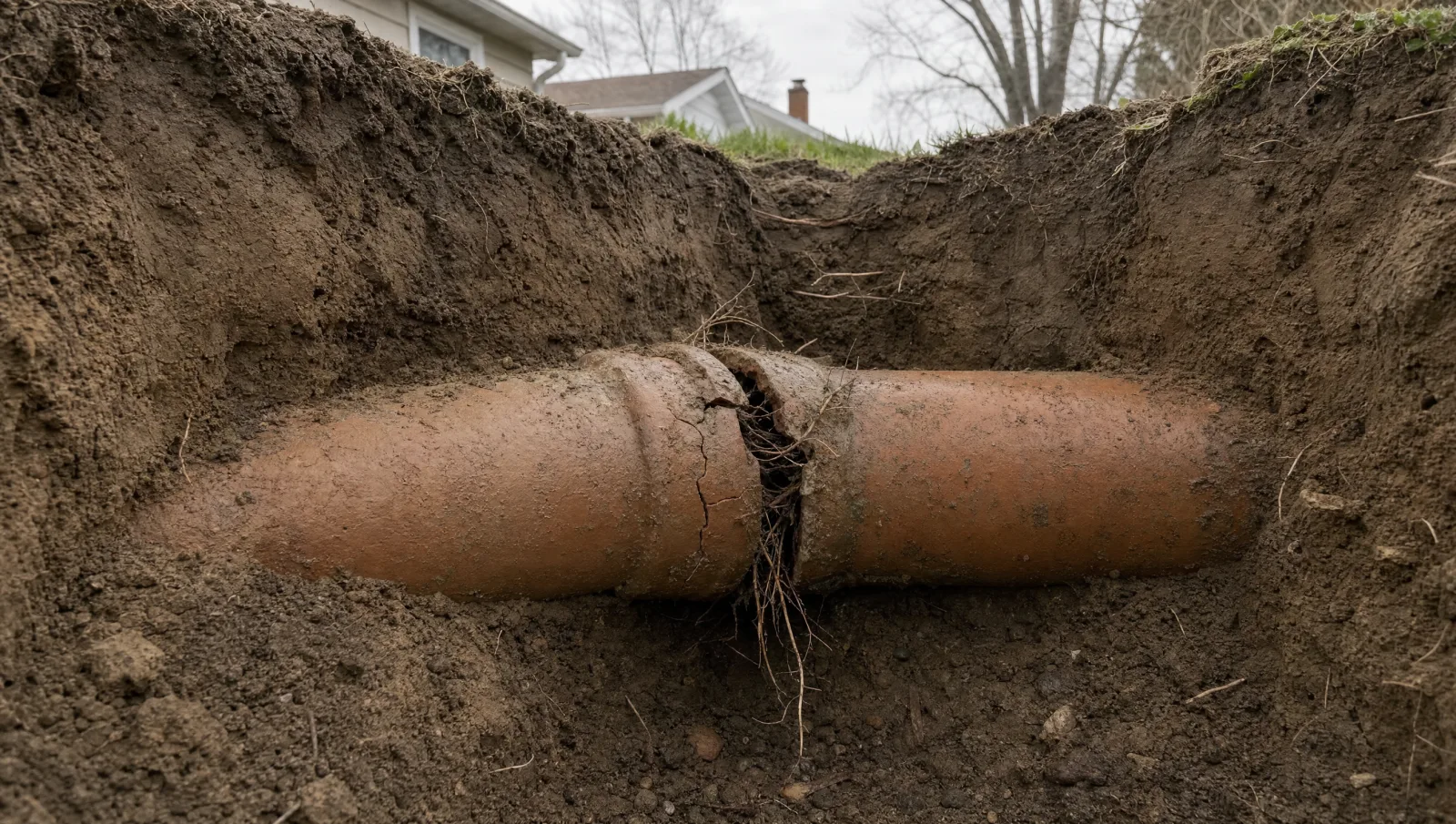
An open excavation trench in a yard exposing a cracked clay sewer pipe joint with fine tree roots growing through the break.

What usually brings people here

  • Backups that return on a cycleA line cleared last year and blocked again this year is describing an ongoing cause rather than a one-off event. The interval itself is diagnostic information.
  • More than one fixture backing up at oncePuts the fault below the point where those fixtures join — the main drain or the lateral running out to the connection. No amount of work at the individual fixtures reaches it.
  • Roots have been found in the line beforeRoots do not break sound pipe. They find an opening that already exists at a joint or a crack, which means a root finding is also a pipe-condition finding.
  • Sewage or waste water appearing at the lowest drain in the houseWaste backing up finds the lowest available opening. A floor drain, a downstairs shower, or a ground-floor toilet is where a lateral problem tends to surface first.
  • A sewer smell that comes and goes with the weatherGas escaping from somewhere it should not. A crack in a buried line lets it out with no water ever appearing, and pressure changes with temperature are why the smell seems to have moods.
  • A pre-purchase scope that stopped short or was too poor to readAn incomplete inspection is not a clean result. A camera that could not pass a certain distance is itself a finding, and it usually means something is in the way.
  • Ground that stays soft, or unusually vigorous growth over the lineA leaking lateral waters and feeds the soil around it. On a lawn the plants notice before the plumbing does.

How the decision actually forks

How the decision actually forksInspection leads to Obstruction? leads to Damage?, then either Cleaning or Repair/replacement.InspectionObstruction?Damage?CleaningRepair/replacement
Obstruction and damage are different findings with different answers. Everything downstream of that fork depends on which one the footage shows.

What has to be established first

  1. Get the line flowing enough to seeA camera cannot see through standing water or past a solid blockage. Restoring partial flow is a prerequisite for the inspection, and it is why a first visit is often clearing rather than deciding.
  2. Camera the full run, with distances recordedWhat the pipe is made of, where the joints are, whether there is root intrusion, cracking, offset, or a low section holding standing water — and how far along each finding sits. That distance measurement is what makes a repair plan specific instead of general.
  3. Distinguish an obstruction from a defectA line full of material that is otherwise intact needs cleaning. A line with a structural fault needs repairing, and cleaning it will work briefly and repeatedly forever. Nearly every disputed sewer quote comes down to which of these two the footage actually shows.
  4. Locate the defect above groundA sonde in the camera head and a locator on the surface put the finding on the property — under the lawn, under the driveway, under the sidewalk. Two identical defects in different places are different jobs, and this is where that difference gets established.
  5. Establish how much of the line shares the problemOne failed joint in a run that is otherwise sound is a spot repair. The same defect repeating every few metres means the pipe is failing generally, and repairing one instance of it buys very little.
  6. Find out where your responsibility endsThe lateral is typically the homeowner's from the house to a defined point, with the public main beyond it. Where that boundary sits relative to the defect changes who does the work, so it gets checked rather than assumed.

What the tools establish

Push camera with distance counter

Shows the inside of the line and how far in each finding sits. It cannot pass a solid blockage, cannot see through standing water, and produces footage of variable quality — a short, murky recording is an incomplete inspection rather than a clean bill.

Sonde and surface locator

Converts a distance along the pipe into a marked spot in the ground, with an approximate depth. This is what a repair is planned against, and it is the difference between digging where the line is and digging where the line was assumed to be.

Cable machine

Restores flow so the line can be inspected, and clears a discrete obstruction. It is a diagnostic enabler here rather than the treatment; on a defective line it will keep working and keep not fixing anything.

Hydro jetting

Cleans the pipe wall back toward full diameter, which both fixes a genuine buildup problem and gives a much clearer inspection. On a cracked or badly corroded line it is the wrong tool, which is why it follows the camera rather than preceding it.

Smoke or dye testing

Finds where a line is open to somewhere it should not be — useful for tracing a persistent smell or an intermittent fault the camera did not catch. It answers "is there a breach and roughly where", not "what does the pipe look like".

The four routes, and what each one assumes

Spot repair

Fits when: One identifiable defect — a cracked length, a separated joint, a section crushed by a root or by settlement — in a line whose remaining footage looks sound.

Trade-off: By far the smallest job, and the right answer more often than the quoting habits of the trade suggest. It rests entirely on the rest of the line genuinely being in good condition, which is a judgement about material and age as much as about the footage — and it is the wrong choice if the same defect appears three times in the same run.

Cured-in-place lining

Fits when: A run with defects distributed along it, where the host pipe still holds its shape and its route, and where what is above it is expensive or disruptive to open.

Trade-off: Rehabilitates a length of pipe with far less excavation, and closes the joints roots were using. It is not universal: it needs a host pipe that has not collapsed, lost its alignment, or sagged, it slightly reduces the internal diameter, and connections along the run have to be reinstated. Where the line has failed structurally, lining is not an option that was rejected — it is one that does not apply.

Open-cut excavation and repair

Fits when: The defect is shallow, in accessible ground, or the pipe has collapsed or lost alignment badly enough that nothing can be worked through it.

Trade-off: The most direct and often the least expensive way to reach a single point, with the cost sitting in the digging and the reinstatement rather than the plumbing. What is above the line decides everything: a lawn, a mature planting bed, a driveway, and a public sidewalk are four very different reinstatement problems.

Full replacement of the run

Fits when: A pipe failing by age and material along its whole length, a run with a sag that ponds waste every time it is used, or repeated defects that make spot repairs a subscription.

Trade-off: The largest and most disruptive job, and the only one that resets the clock rather than extending it. Replacement can be done by excavation or by pipe-bursting a new line along the old route where conditions allow. It is worth arguing against when one defect explains everything found, and worth arguing for plainly when it does not.
How a repair runs

  1. Inspection and locationCamera the line, record distances, mark the defect on the surface, and establish depth. Nothing is priced before this exists.
  2. Scope written downWhat is being repaired, over what length, by which method, and what happens to the surface above it. In plain language, so it can be held up against anyone else's proposal.
  3. Permits and utility locatingExcavation work needs the other buried services marked before anything is dug, and work in the public right of way has its own permitting. This is scheduling reality rather than paperwork for its own sake, and it is worth knowing about before the day.
  4. AccessEither an excavation to the marked point, or access pits at each end for a lined or burst run. Site protection and where spoil goes are agreed before the ground is opened.
  5. The repair itselfReplace the defective section, install and cure the liner, or pull the new line through. This is frequently the shortest part of the whole job.
  6. Verification and reinstatementA camera pass over the repaired section, then backfilling and putting the surface back. You should expect the after footage as well as the before.

What moves the number on a lateral

What is above the line

Bare lawn, a planted bed, a concrete driveway, and a public sidewalk are four different reinstatement jobs for the same length of pipe below them. This routinely matters more than the plumbing.

Depth of the run

A deep lateral means more excavation, more spoil, and shoring requirements that a shallow one does not trigger. Depth is established by the locate, not estimated from the house.

Length of pipe affected

One failed joint and twenty metres of degraded pipe are the same finding at very different scales, and it is the reason a second opinion on a quote so often turns on the footage rather than the price.

Pipe material and general condition

Whether the surrounding pipe can host a liner, tolerate a pull-through, or support a spot repair is a material question, and it removes or restores whole options before cost is discussed.

Where the property boundary sits

Work in the public right of way brings permitting, traffic control, and specified reinstatement standards. Two identical repairs on either side of that line are not comparable jobs.

Access for equipment

A back garden reachable only through the house, a narrow side return, or a line under a structure constrains which machinery can be used and turns a routine excavation into a careful one.

Sewer laterals in San Diego housing

A postwar house here may still be on its original clay lateral, and that possibility is worth establishing rather than assuming either way. Clay itself is durable and routinely outlasts what people expect of it. Its weakness is that it is laid in short sections with a joint between each one, and joints move — ground settlement shifts them, and once a joint has stepped out of line, the pipe has an opening in it. That is the mechanism behind nearly every root finding: the roots did not break a sound pipe, they found a gap that already existed and followed the moisture through it. Cast iron of a similar era fails along a different path, corroding from the inside until the wall thins and the invert breaks down. Where there are established trees on a lot, that mechanism has something to act on. A root system grows toward a reliable source of water rather than staying near the trunk, which is why the point of entry is frequently a long way from the tree that produced it — and why the tree in the front garden is not automatically the culprit. The practical consequence is easiest to state for a buyer. A sewer scope is not part of a standard home inspection, and it is one of the few additional inspections that regularly finds a problem large enough to change what a house is worth. On an older property it is worth doing on its own merits, and a recording that is short, murky, or stops early has not given the line a clean bill — it has failed to inspect it.

Where sewer line repair comes up most

La Mesa's combination of mature trees and old clay laterals is the county's clearest root-intrusion pattern, and Chula Vista's older bayside core carries the same original-lateral risk on a smaller scale.

    Questions people ask

    How do I know whether I need a repair or just another cleaning?

    By what is inside the pipe, which means camera footage. If the line is intact and was full of material, cleaning is the answer and it will hold. If there is a crack, a separated joint, a sag holding standing water, or roots coming through an opening, cleaning restores flow temporarily and changes nothing. A line that has been cleared more than once and keeps failing has already given you a strong hint about which of those it is.

    Is trenchless always better than digging?

    No. Lining and pipe-bursting avoid a lot of excavation, which is genuinely valuable under a driveway or a mature garden, but they have preconditions: the host pipe has to be intact enough to line or to pull through, alignment has to be sound, and connections along the run have to be reinstated. Where a single shallow defect sits under a lawn, open-cut is usually simpler, quicker, and less expensive. Trenchless is one of four options, not the modern answer that replaces the others.

    What part of the sewer line am I responsible for?

    Typically the lateral from the house to a defined point at or near the property boundary, with the public main beyond that — but where exactly that boundary sits varies, and it is worth establishing before agreeing to any work. It matters enormously to cost: the same defect a metre either side of the line is either your excavation and permitting problem or the utility's.

    The camera stopped partway down the line. What does that mean?

    It is a finding, not an absence of one. A camera stops because something is in the way — a hard blockage, a collapse, a badly offset joint, or a bend it cannot negotiate. What it does not mean is that the rest of the line is fine, because the rest of the line was never seen. If a pre-purchase scope stops early, the honest description is an incomplete inspection, and it is reasonable to ask for it to be completed.

    Can roots be dealt with permanently without replacing the pipe?

    Cutting or jetting roots removes the mass and buys time, sometimes years, but it does not close the opening they came in through, so they grow back toward the same moisture along the same path. A durable answer means sealing that opening — lining the affected section or replacing the run where the joints have failed. That distinction is worth insisting on, because "we cleared the roots" and "the roots cannot get back in" are very different pieces of work.

    How disruptive is this going to be to my property?

    It depends almost entirely on what is above the line and how deep it runs, which is why the locate happens before anything is priced. A shallow spot repair under a lawn is a small excavation and a reseeded patch. A run under a driveway, or work extending into the public right of way, involves surface removal, permitting, and reinstatement to a specified standard. You should get that described concretely before you commit, not discovered on the day.

    I have two very different quotes for the same line. How do I judge them?

    Compare the findings rather than the prices. Ask each for the footage, the distance measurements, and the specific defect they are proposing to fix. Two honest quotes that disagree usually disagree about how much of the line is affected — one is repairing a defect, the other is replacing a run — and that is answerable by looking. Two prices with no footage behind them are not comparable at all.

    Describe the backup

    Which fixtures, how often, and what has been done to the line before — including anything a camera found. If you have a scope video from an inspection or a previous visit, that is the most useful thing you can send.

    Request Service