Water heater replacement in San Diego, and when a repair is the better answer

Where the water is coming from settles it. A fitting, a valve, or a connection is a repair; the tank body itself has no repair, and an indoor unit that lets go is a flooring and drywall problem rather than a plumbing appointment.

Tell us what the heater is doing
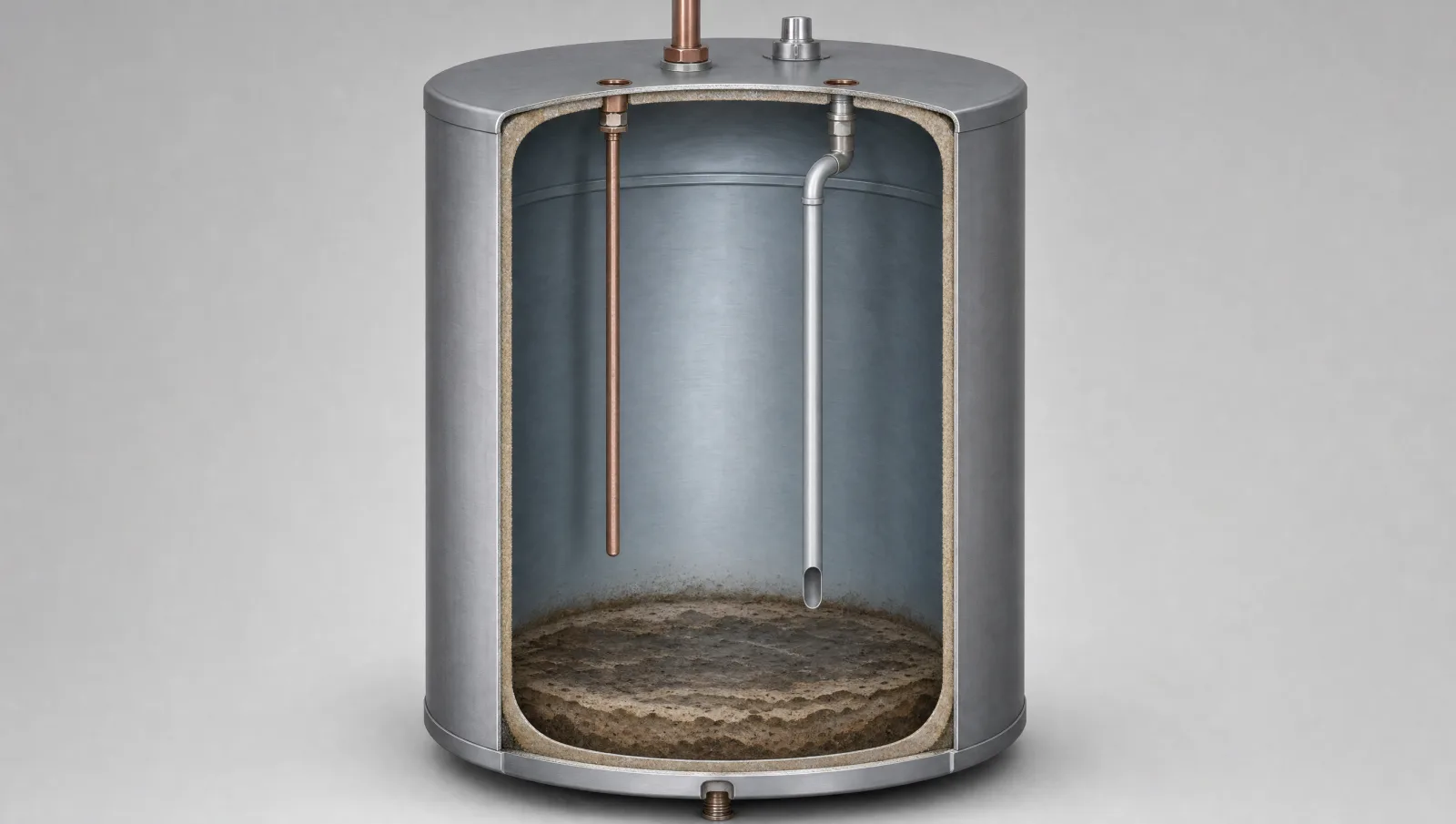
Cutaway illustration of a residential storage water tank showing sediment collected across the base around the dip tube.

What people notice before a heater fails

  • Water pooling around the baseThe question is where it originated. Condensation and a weeping fitting both put water on the floor and mean completely different things from a tank that has corroded through.
  • Rusty or discoloured hot waterRust arriving only on the hot side points at the tank interior or a spent anode rod. On both sides it points at the supply pipework instead, which is a different problem entirely.
  • Rumbling, popping, or knocking during a heating cycleSediment across the tank base with water trapped underneath it flashing to steam. It is not dangerous in itself, but it means the burner is heating sediment before it heats water.
  • Hot water runs out faster than it used toUsually sediment occupying volume the tank used to hold water in, or a broken dip tube mixing incoming cold straight into the outlet. It can also be a hot-side leak somewhere else in the house pulling heated water away continuously.
  • The pilot will not stay lit, or there is no sparkA control or ignition fault, and on its own a repair rather than a replacement. Age matters here only in whether the parts are still obtainable.
  • Corrosion around fittings, nipples, or the tank seamSurface rust at a threaded connection is often addressable. Rust blooming out of a seam or the tank body is the tank telling you it has been leaking for a while.
  • The relief valve dischargesA safety device doing its job, which means something upstream is wrong — excessive temperature, or system pressure with nowhere to expand to. Capping or ignoring it is the one response that is genuinely unsafe.

Repair or replace, by where the failure is

Repair or replace, by where the failure is
 Repair is reasonableReplacement is the honest answer
Where the water is coming fromA fitting, a union, the drain valve, the relief valve, or a supply connection above the tank. All of those are serviceable parts.The tank body or a seam. The glass lining has failed and the steel has corroded through, and there is no repair for that — welding or sealing a tank is not a thing that is done.
What has failedThermostat, thermocouple, igniter, gas control, heating element, anode rod, or dip tube. Parts, not the vessel.The vessel itself, or a failure alongside multiple other worn components on a unit near the end of its service life.
Age of the unitA younger unit with one identifiable fault. Age is context and not a verdict — an older heater that is not leaking is not automatically due for replacement.An older unit where the failure is the tank. Here the age explains the failure rather than excusing it.
What happens if you waitA dripping fitting stays a dripping fitting. Nothing about it is on a countdown.A corroded tank gets worse and only worse. A tank that eventually opens up releases its entire contents plus whatever the supply keeps feeding it until someone closes a valve.
Where the unit is installedGarage or exterior installation with a drain nearby — a slow failure has somewhere to go and buys you time to decide.Interior closet, upstairs, or over finished floor. The consequence of being wrong is a water damage claim, and that changes how much benefit of the doubt a marginal tank deserves.

Why water heater replacement in San Diego is usually a tank decision

A storage water heater is a steel vessel with a thin glass lining, holding hot water under mains pressure for its entire life. Everything bolted to it — thermostats, valves, elements, igniters, the anode rod — is a replaceable part. The vessel is not. The lining is what keeps the water off the steel, and it is never perfect; the sacrificial anode rod exists to corrode instead of the tank wherever the lining is imperfect. When the anode is used up and not replaced, the corrosion moves to the steel. That process runs quietly for years, and the first outward sign is usually water appearing at the base — which is the tank reporting a failure that started long before. Sediment is the other half of the story. Minerals precipitating out of heated water settle across the base, insulating the water from the burner below it. The unit works harder for the same hot water, the popping noise starts, and the trapped heat is hard on the lining exactly where it is already thinnest. Draining and flushing on a sensible schedule slows this considerably, which is why maintenance is genuinely worth something on a tank and why an unmaintained unit ages faster than its label suggests. So the diagnostic question is narrow and answerable: is the water coming from a part or from the vessel? A part is a repair. The vessel is a replacement, regardless of how new or old the unit is.

Establishing which failure you have

  1. Find the actual origin of the waterDry everything, then watch where it reappears. Water runs down the outside of a tank and pools at the base regardless of where it started, so a puddle on the floor identifies nothing on its own. A fitting drip, a relief valve discharge, and a seam weep all look identical after an hour.
  2. Rule out the things that are not the heaterCondensation on a cold day, a leaking connection above the unit, an overflow pan draining from something else, or a relief valve doing its job because system pressure has nowhere to expand. Each of those has been mistaken for a failed tank often enough to be worth checking first.
  3. Check the safety furnitureRelief valve, discharge pipe termination, venting on a gas unit, seismic strapping, and the expansion arrangement. These get assessed regardless of the outcome, because a unit that is otherwise fine can still be installed in a way that needs attention.
  4. Assess the parts individuallyThermostat, control, ignition, elements, anode, and dip tube each fail in recognisable ways. Naming the failed part is what makes a repair possible, and it is also what stops a single fault being used as an argument for replacing the unit.
  5. Judge the tank itselfCondition of the seams and fittings, how much sediment is present, whether the anode has been replaced in its life, and whether rust is coming out of the vessel or off the outside of it.
  6. Say plainly which one it isA repairable fault on a serviceable unit is a repair, including on an older heater. A failed tank is a replacement, including on a younger one. The two questions do not average into a recommendation.

If it is being replaced, what the choice actually commits you to

Like-for-like storage tank

Fits when: The existing installation works, the capacity suits the household, and the gas or electrical supply and venting are already right for it.

Trade-off: The simplest and least disruptive replacement, because the connections, the vent, and the space were designed for this. It reproduces the same lifespan and the same eventual failure, which is a reasonable trade when the unit served its full life without incident.

Storage tank, resized or relocated

Fits when: The household outgrew the tank, or the unit sits somewhere a failure would be expensive — an interior closet or above finished floor — and there is a better position available.

Trade-off: Solves a problem the old unit had rather than only replacing it. Resizing has to respect what the supply and vent can carry, and relocating means new pipe runs, new venting, and a drain arrangement at the new position.

Tankless

Fits when: Hot water demand is spread through the day, the space the tank occupies is worth reclaiming, and the gas supply and venting can be brought up to what the unit needs.

Trade-off: Heats on demand, so there is no stored volume to run out and no tank standing by to fail. The honest caveats: a gas tankless typically needs a larger gas line and its own venting, so the installation is a bigger piece of work than swapping a tank; simultaneous heavy demand is limited by flow rate rather than by tank size; and hard water makes descaling maintenance a real ongoing obligation rather than an optional one. It suits some households very well and is a poor fit for others.

Repair and keep it

Fits when: The failure is a part, the tank is sound, and the unit is doing its job otherwise — including when the unit is old.

Trade-off: By far the cheapest outcome and frequently the correct one. It is worth stating explicitly because "it is fifteen years old" gets used as a diagnosis when it is only context. What it does not do is buy certainty: a sound tank today is a sound tank today.
What a replacement day involves

  1. Confirming what goes inFuel type, capacity, physical dimensions against the space, and what the existing gas or electrical supply and venting will carry. This is settled before the unit is ordered, not on the day.
  2. Isolating and drainingWater and fuel or power off, tank drained down. A tank full of sediment drains slowly, and that is the part of the morning that most often runs long.
  3. Removing the old unitDisconnecting and getting it out, which is a physical problem in a tight closet or up a stair. Access is worth mentioning when you first describe the job.
  4. Setting and connecting the new onePositioning, connecting water, connecting gas or electrical, venting, seismic strapping, and the relief valve with its discharge pipe correctly terminated. The bracketing and the discharge routing are code items, not optional tidiness.
  5. Filling, purging, and firingFilling with the air purged out, then bringing it up to temperature and checking for leaks at every connection under working pressure — before anything gets closed up.
  6. Handing it overWhere the isolation valves are, how to shut it down in a hurry, what the relief valve discharge should and should not be doing, and how to drain it periodically. The last one is the difference between a heater that reaches its expected life and one that does not.

What local water does to a tank

Sediment is not an abstraction here, because the water is hard. San Diego's own reporting puts total hardness in the region of 216 to 284 ppm — roughly 12.6 to 16 grains per gallon — and the figure moves with which treatment plant serves an address and with the seasonal blend of Colorado River and State Water Project supply. That is the number behind the popping noise and the layer at the bottom of the tank. The mechanism is simple. Minerals in solution come out of solution when the water is heated, and they settle in the one place in the system where hot water sits still: the base of the tank, directly over the burner on a gas unit. That layer insulates the water from the heat, so the burner runs longer for the same result, and the trapped heat works on the glass lining exactly where the lining is being asked to do the most. A tank in hard water that is never drained accumulates that layer for its whole life. Two practical consequences follow, and neither depends on which brand of heater is installed. Periodic draining and flushing genuinely pays for itself here in a way it would not somewhere with soft water — it is the cheapest maintenance in the house. And on a tankless unit, descaling stops being an optional nicety: the heat exchanger has narrow passages, hard water scales them, and a unit installed without a plan for descaling is one that will disappoint someone in a few years.

What moves the number

Whether the installation stays as-is

A like-for-like swap into an existing, compliant setup is the shortest version of this job. Every change — capacity, position, fuel, type — adds work beyond the unit itself.

Access to where it sits

A garage against an outside wall and an interior upstairs closet are the same appointment on paper and very different mornings in practice, both getting the old one out and the new one in.

What the existing supply and venting will carry

This is where a tankless conversion diverges from a tank swap. A larger gas line, new venting, or an electrical upgrade is real work that has nothing to do with the appliance price.

Bringing the installation up to current requirements

Seismic strapping, expansion provision, relief valve discharge routing, drain pan and its outlet. An older installation frequently predates some of these, and they are addressed at replacement because that is when the unit is off the wall.

Whether anything got wet

A tank that failed indoors brings flooring, drywall, and drying into the job. That part is regularly larger than the heater, and it is the reason a marginal tank in an interior space deserves less benefit of the doubt.

Disposal and the unit itself

Capacity, efficiency, and type all move the equipment side, and the old tank has to go somewhere. Neither is the interesting variable, but both are part of the total.

Where water heater strain shows up most

El Cajon's inland summer heat puts more cycling strain on a water heater than the coast does, and Oceanside's older beachside homes combine ageing units with a harsher exterior environment.

    Questions people ask

    My water heater is leaking. Does it definitely need replacing?

    Only if the water is coming from the tank itself. Water at a fitting, a union, the drain valve, or the relief valve is a repair, and those are common. Water seeping from the tank body or a seam means the steel has corroded through, and there is no repair for that — a tank cannot be patched back into service. Dry everything thoroughly and watch where the water reappears, because it runs down the outside and pools at the base whatever the origin.

    Should I replace a heater that is old but working fine?

    Not automatically, and being told to is not by itself a reason. Age is context: it tells you how much life has probably been used, not that a failure is imminent. What is worth doing on an older unit is looking at the things that predict trouble — sediment, the state of the anode, corrosion at the seams and fittings — and at where it is installed. An old tank in a garage with a drain nearby can reasonably be run on and watched. The same tank in an upstairs closet is a different risk calculation, because the cost of being wrong is not the heater.

    Is tankless worth it?

    It depends on the house more than on the technology. It suits households whose hot water use is spread through the day, and it reclaims the space the tank occupied. Against that: a gas unit typically needs a larger gas line and its own venting, which makes the install a bigger job than a straight swap; heavy simultaneous demand is limited by flow rate rather than by stored volume; and descaling becomes a real maintenance obligation. Anyone recommending it without asking how your household uses hot water and what your gas supply looks like is recommending a product rather than answering a question.

    Why does my hot water run out sooner than it used to?

    The three usual explanations are sediment taking up volume the tank used to hold water in, a broken dip tube letting incoming cold mix straight into the outlet, and a thermostat or element fault on an electric unit. There is a fourth worth ruling out: a hot-side leak elsewhere in the house pulls heated water away continuously, so the heater is refilling and reheating around the clock and still falling behind. If the bill has also climbed, that fourth one moves up the list.

    What is the noise coming from my water heater?

    Rumbling or popping during a heating cycle is almost always sediment across the base, with water trapped underneath it flashing to steam. It is not dangerous in itself, but it means the burner is heating a layer of mineral before it heats the water, which is inefficient and hard on the lining exactly where it is most vulnerable. Draining and flushing helps if it is caught reasonably early; on a heavily sedimented old tank it can be too late to make much difference.

    Water is coming out of the pipe from the relief valve. Is that a problem?

    It means the valve is doing what it exists to do, which is a good thing, but something is making it necessary. Either the water is too hot, or the system pressure has risen with nowhere to expand to — which is common where a check valve or pressure regulator means the plumbing cannot push back toward the street. Both are addressable. The one response that is genuinely unsafe is capping the valve or blocking the discharge pipe.

    How long should a water heater last?

    Long enough that any specific number would be misleading for your unit. What actually decides it is water chemistry, whether the anode rod was ever replaced, whether the tank was drained periodically, and how hard the household ran it. Two identical heaters installed the same week can be years apart in condition. The useful signals are the ones on this page — rust from the vessel, sediment noise, corrosion at the seams — rather than the date on the label.

    Tell us what the heater is doing

    Where the water is appearing, what noise it makes, and where the unit is installed — garage, closet, upstairs. If you can tell whether the water starts at a fitting or lower down at the tank, that is the detail that decides repair or replace.

    Request Service