Water under flooring, showing up in the wrong room

Flooring that has gone soft, dark, cupped or lifted is reporting where water arrived. Where it came in is a separate question, and answering it in the right order is what keeps the repair small.

Tell us what the floor is doing
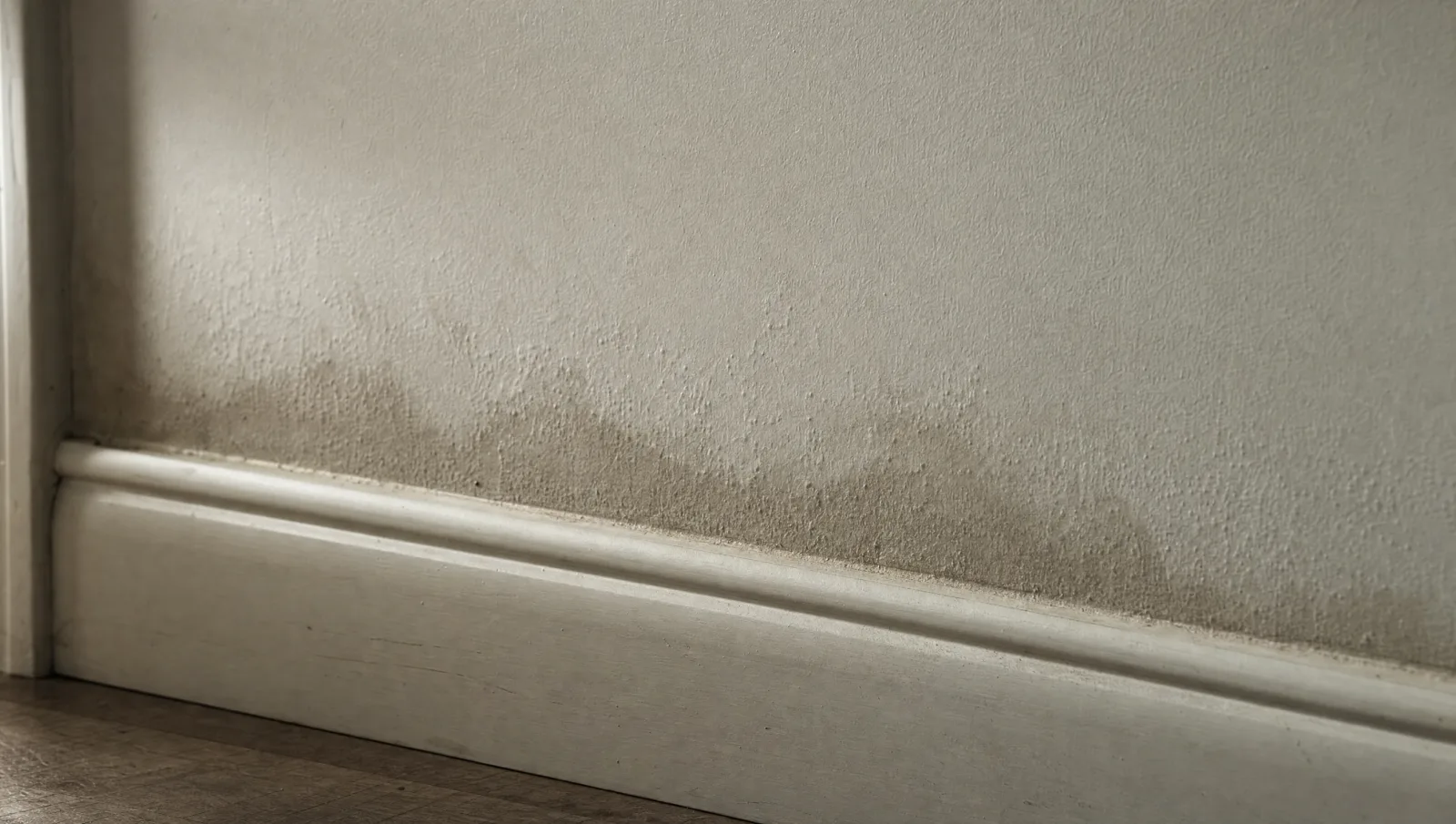
Close view of a baseboard and lower wall with a dark tidemark of moisture wicking upward through the paint.

What water under flooring is actually telling you

Water under flooring is water that has already travelled. It reaches the visible spot by the easiest route available — sideways along the top of a slab, down a stud cavity and out at the plate, or along a joist until it meets something absorbent — and it surfaces where the floor covering is least able to keep it out. That means the damp area maps the drainage of your building, not the position of the failure. There are only a few things it can be, and they behave differently. A pressurised supply leak feeds continuously, so the area grows whether or not anyone is using water, and a hot-side one often leaves the floor warm. A drain or waste fault only wets the floor when the fixture above it is used, so it comes and goes on a schedule that matches the household. Ground moisture rising through a slab is broad and seasonal rather than concentrated. And an appliance or a shower pan failing leaks in one small place, repeatedly, near the fixture itself. Separating those four is the entire diagnostic job, and each of them is distinguishable without opening the floor — by when the water appears, by whether the meter moves, by temperature, and by how far the moisture extends compared with where it is visible.

What the floor is doing, and what each pattern suggests

  • The damp area grows steadily and never dries backContinuous feed. A pressurised supply line is the leading candidate, because nothing else runs when the house is asleep.
  • It appears after showers or laundry and dries betweenIntermittent feed tied to use. That points at a waste or drain fault, a shower pan, or an appliance connection rather than the supply.
  • One area of floor is warm as well as dampA hot-water line under the slab. Warmth with no heating system beneath it is one of the more specific signs available.
  • Boards have cupped, tiles sound hollow, or vinyl has lifted at the edgesMoisture arriving from underneath over a sustained period. A spill from above dries; something below keeps feeding it.
  • A dark tidemark climbing the baseboard or the bottom of the drywallWater wicking upward out of the floor structure. It marks the lowest point water reached, which is a boundary, not a source.
  • A musty smell that arrived before any visible damp didMaterial under the covering has been wet for a while. The visible stage is late in the sequence, not early.

Working backwards from the wet spot

  1. Watch the meter with the house idleContinuous movement with every fixture and the irrigation off means a pressurised line is losing water. A still meter effectively rules out the supply side and moves the search to drains, fixtures and ground moisture.
  2. Note when the water appearsKeep track for a couple of days of whether the damp grows overnight or only after certain fixtures run. That timing separates a supply leak from a waste leak more reliably than any single instrument does.
  3. Map how far the moisture actually goesMoisture meters read through the covering and show the true extent, which is nearly always larger than the visible stain. The shape of that map — a narrow track versus a broad wet field — says a great deal about how the water is arriving.
  4. Locate the source with the method that suits the suspectAcoustic equipment for a pressurised line, thermal imaging to trace a hot-side run, camera inspection for a drain or waste line. They answer different questions, and choosing the wrong instrument returns a confident answer to the wrong one.
  5. Deal with the drying separately from the plumbingStopping the water and drying what it soaked are two different jobs. Making good over material that is still wet is how a repaired leak becomes a recurring smell.

Once the source is confirmed

Spot repair at the failure

Fits when: A single discrete defect on a line that is otherwise sound — one joint, one puncture, one fitting.

Trade-off: The smallest and least invasive route. It relies on the rest of the line being in good condition, which is only a safe assumption when the material and age support it.

Reroute the affected run

Fits when: The failure sits under a slab, a tiled floor, or anything else expensive to open, and there is a practical path through walls or attic instead.

Trade-off: Avoids breaking concrete altogether. It uses more pipe and leaves the old section abandoned in place, which is normal practice rather than a compromise.

Open the floor over the marked spot

Fits when: Access is straightforward, or a reroute is impractical for that particular run.

Trade-off: Direct and durable. The cost sits in the access and the reinstatement of the floor rather than in the plumbing itself.

Replace the section or repipe

Fits when: Repeat failures on the same lines, or a pipe material that is failing by age along its length rather than at one point.

Trade-off: The largest job, and the only one that ends the pattern. It is worth raising honestly on a second or third failure, and worth arguing against on a first.
Why this is a slab problem so often in San Diego

Slab-on-grade has been the standard foundation here since the tract building of the 1950s, which means a great deal of supply pipe sits inside or beneath concrete with no access panel, no crawlspace, and nothing to lift. A line in that position has no service access at all — and when one fails, the water has nowhere to go but sideways, along the top of the slab and into the gravel below it, surfacing through the floor covering wherever the resistance is lowest. The age of the house matters for a separate reason. A home from the postwar era may still be on its original galvanised supply lines, which corrode internally along their whole length rather than failing at one point. That distinction changes the answer to "repair or replace" before anyone has looked at a single joint, which is why the age and material of the pipe gets established alongside the location of the leak rather than after it.

Questions people ask

Can I just dry the floor and see whether it comes back?

Drying is worth starting, but on its own it answers nothing — if the source is a pressurised line, the floor will simply get wet again, and the material will have spent extra weeks saturated in the meantime. Run the meter test first. If water is leaving the system continuously, drying is the second half of the job, not the first.

The water only appears after a shower. Is that still a leak?

Yes, but a different one, and that timing is genuinely useful. Water that arrives only when a fixture drains points at a waste line, a shower pan, or a seal rather than a supply line, and those are found with a camera and a controlled test rather than with acoustic equipment. It also means the meter test will come back clean, which is information rather than a dead end.

Do you have to break the concrete to find it?

Not to find it. Locating works through the slab — acoustically for a pressurised leak, thermally for a hot-side one. Concrete gets opened as part of the repair once the spot is confirmed, and even then a reroute sometimes avoids it entirely. Anyone opening the floor in order to search has the sequence backwards.

Is standing water near an outlet or appliance dangerous?

Treat it as dangerous. Do not stand in water to reach a plug, an appliance, or a panel. If water is near outlets, an appliance, or any electrical equipment, cut power to that area at the breaker before going near it — and if you cannot do that safely and dry, leave it and get an electrician. Water on a floor is a plumbing problem you can wait on; water plus electricity is not.

How much of the flooring will have to come up?

That depends on how far the moisture actually spread, which is what mapping establishes, and it is usually more than the visible stain. Material that can dry in place is left in place. Material that has delaminated, cupped permanently, or holds moisture against a subfloor generally cannot be saved, and leaving it is what produces a smell after the plumbing is fixed.

What should I record before the repair starts?

Photograph the affected area before anything is moved, lifted or dried, note the date you first saw it, and keep whatever the diagnosis produces in writing — the source, its location, and how far the moisture extends. Once a floor is opened and dried, the evidence of what it looked like is gone. Documenting the damage and the cause before repair is what any claim will need, and it is also what makes a second opinion possible.

Tell us what the floor is doing

Which room, how large the area is, whether it is growing, and whether it appears at particular times of day or after particular fixtures run. That timing tells us which instrument to bring.

Request Service