Sewer Line Repair
Establishing what is actually wrong with the lateral before choosing how to fix it.
San Diego water, leak, drain and sewer diagnostics — find the source before anyone opens a wall.
WaterLine ExpertsTwo contractors can quote the same 50-foot run at very different numbers honestly, because "trenchless" is not one method — it is two, with different requirements and different price floors, and a camera pass is what decides which one applies before either number means anything.
Get a scope-based estimate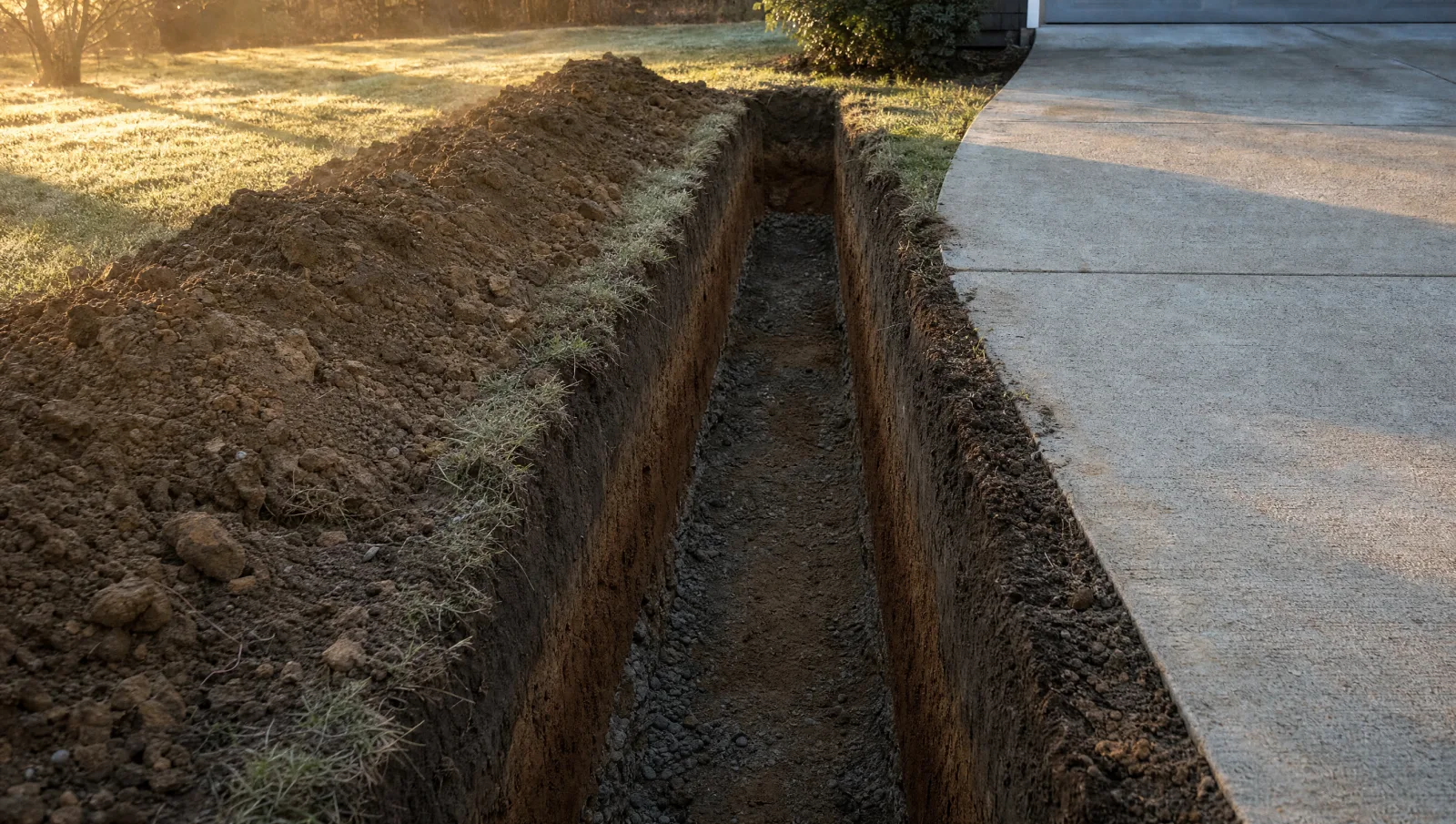
Trenchless sewer repair cost gets quoted as a single figure in most advertising, which is misleading in a specific way: pipe bursting and cured-in-place lining (CIPP) are different jobs with different equipment, different site requirements, and different price floors, and a line that qualifies for one does not automatically qualify for the other. CIPP lining pulls a resin-saturated liner through the existing pipe and cures it in place, so it needs a host pipe that has not collapsed or lost its shape — a line with a bellied sag, a crushed section, or a full collapse cannot be lined, full stop. Pipe bursting pulls a new pipe through while a bursting head fractures the old one outward into the surrounding soil, so it works on a collapsed line that lining cannot touch, but it needs enough clearance from other utilities to burst outward safely and slightly larger entry and exit pits. That difference is where two honest quotes for the same address diverge. A contractor who scoped the line and found it collapsed will quote bursting. One who has not looked yet may quote lining because it is usually the cheaper number to lead with. Neither quote is wrong on its own terms — only one of them is buildable once the camera actually runs.
| Pipe bursting | CIPP lining | |
|---|---|---|
| What it needs from the existing pipe | Nothing — it fractures the old pipe outward as the new one is pulled through, so a collapsed section is not disqualifying. | A host pipe that still holds its round shape. A collapse, a bad belly, or a crushed section rules lining out entirely. |
| Access needed | Entry and exit pits, typically larger than lining’s, and clearance to burst outward without striking other utility lines. | Two smaller access points, since the liner travels through the existing pipe rather than displacing soil around it. |
| Result | A full-diameter new pipe, in a new material, same route. | A slightly reduced internal diameter, since the liner adds a wall inside the old one. |
| Typical cost driver | Priced closer to the higher end of the trenchless range because of the larger pits and the burst-clearance survey. | Usually the lower-cost trenchless option when the host pipe qualifies, since less soil moves. |
| When it is the only option | Collapsed or badly deformed pipe, or a material change is required and lining is not permitted for it locally. | Sound but deteriorating pipe with failed joints or root intrusion, where the shape is still intact. |
| What rules it out | Utilities or structures too close to burst outward into safely. | Any collapse, severe belly, or offset the camera confirms. |
Industry cost surveys (Angi, HomeGuide, and multiple trenchless contractor cost guides, 2025–2026) put trenchless sewer repair broadly in the $80–$250 per linear foot range, with a typical residential lateral landing around $4,000–$20,000 — and lining generally sits at the lower end of that band while bursting sits at the higher end, so the method decided by the camera moves the estimate before length does.
Price is usually quoted per linear foot, and depth changes the pit work at both ends regardless of method.
A pit through bare soil is a different cost than one through a driveway, a patio, or a section of hardscape that has to be cut and restored.
Every branch or lateral tying into the main run has to be reinstated after lining, or reconnected after bursting — more connections means more time on site.
A camera pass that already exists shortens the estimate process; one that has to be scheduled first is a separate line item, not a delay for its own sake.
Sewer lateral work in San Diego County typically requires a permit and a final inspection before the connection is signed off — build that timeline in rather than treating it as optional paperwork.
Often, but not automatically. Open-trench replacement avoids the pit-clearance and equipment costs specific to bursting or lining, and on a very short, very shallow, easily accessed run under bare soil, the two methods can land close together. Trenchless tends to win by a wider margin as depth, length, or surface restoration (concrete, hardscape, mature landscaping) increases, because that is exactly the cost open-trench work cannot avoid.
Ask both what they saw on camera and how far the scope ran. Lining requires an intact host pipe; if one contractor’s footage shows a collapse, a severe belly, or an offset the other missed or did not reach, that is the deciding fact, not a difference in preference. A quote given without a full camera pass is a placeholder, not a diagnosis.
Lining does, slightly — the cured liner adds a wall inside the existing pipe, narrowing the internal diameter by roughly the liner’s thickness. For a residential lateral that reduction is rarely enough to affect flow. Bursting does not reduce capacity; it replaces the pipe outright, usually at the same or a larger diameter.
Not an honest one. A number given before the scope is an estimate of the average case, and the average case is not what is under your yard. The camera pass is what turns a range into a quote — everything before that is a placeholder that both sides should treat as one.
Most single-line residential jobs, once pits are open and equipment is on site, complete the actual bursting or lining pass in a single day. What extends the timeline is everything around it — permit approval, utility locates, and surface restoration if a driveway or patio sits over the access points.
Rarely, unless the policy specifically includes a service-line rider — standard homeowner’s coverage generally treats a failed sewer lateral as normal wear rather than a covered peril. Some utilities offer optional service-line protection plans separately from insurance; it is worth checking before assuming either way rather than after the work is done.
Tell us the length of the run if you know it, how old the pipe is, and whether it has been scoped before. If you have prior camera footage, that alone can tell us which method your line qualifies for before anyone visits.
Request ServicePrefer to call? (619) 391-3249